




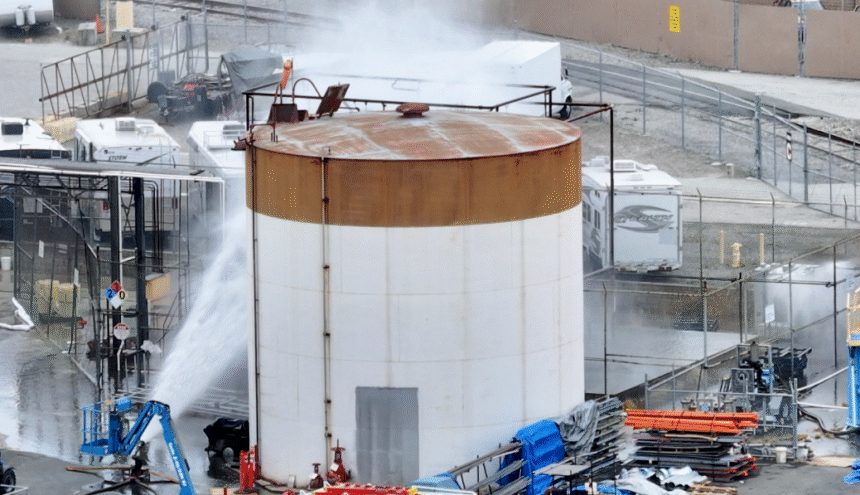
Thousands of residents in Southern California were allowed to return home Tuesday after authorities eliminated the risk of a potentially catastrophic chemical tank explosion that had forced widespread evacuations for several days.
The emergency centered on a 7,000-gallon tank containing methyl methacrylate, a toxic and highly flammable chemical, at a GKN Aerospace facility in Garden Grove. The problem was first identified on Thursday when officials discovered vapor escaping from a pressure valve.
By Tuesday evening, the Orange County Fire Authority announced that the danger had passed, stating there was no remaining threat of explosion, fire, chemical release, or harm to the public. As a result, all evacuation orders related to the incident were lifted.
At the height of the emergency, approximately 60,000 residents in Garden Grove and neighboring communities were ordered to leave their homes. While most evacuation zones were cleared on Monday, about 16,000 residents remained displaced until authorities were confident the situation was fully under control.
During a community meeting Tuesday, some residents raised concerns about the storage of hazardous chemicals in a densely populated area. Garden Grove Mayor Stephanie Klopfenstein said investigations would be conducted by city, state, and federal agencies to determine what caused the incident and whether any regulations were violated.
Emergency crews responded to the facility after receiving a 911 call Thursday afternoon reporting an active leak. Officials later determined that a malfunction in the refrigeration system allowed the tank’s temperature to rise above its intended operating level of 50 degrees Fahrenheit, increasing internal pressure.
Incident Commander Craig Covey said the tank came dangerously close to exploding. Firefighters worked continuously to cool the container, using both the facility’s sprinkler system and a high-volume water stream that delivered roughly 1,250 gallons per minute. Those efforts successfully reduced the pressure inside the tank.
Officials reported that the tank’s temperature exceeded 100 degrees over the weekend before gradually dropping to 92 degrees by Tuesday. A crack that developed in the tank also helped relieve pressure, allowing crews to implement additional safety measures.
Authorities had feared a boiling liquid expanding vapor explosion, known as a BLEVE, which could have caused severe damage and posed significant risks to surrounding communities.
GKN Aerospace said it continued to work closely with the Orange County Fire Authority, the Environmental Protection Agency, and other agencies throughout the incident. The company apologized for the disruption and said protecting the safety of residents and workers remained its highest priority.