



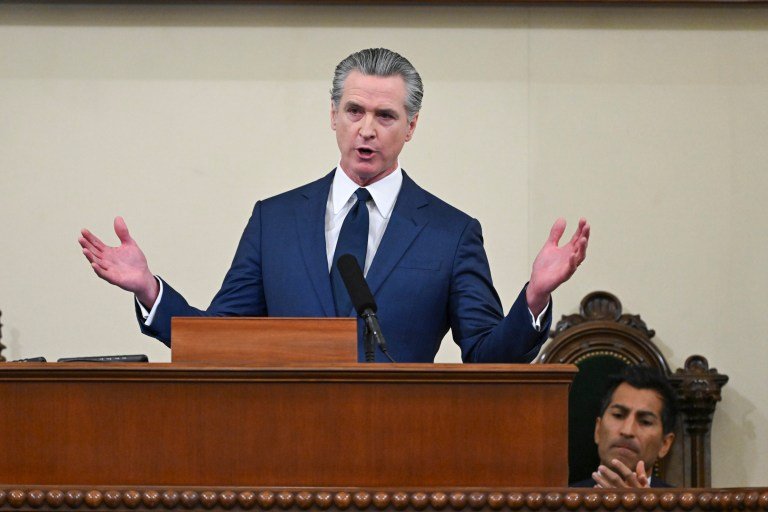
Standing beneath the Capitol rotunda in Sacramento, Gov. Gavin Newsom used his final State of the State address to draw a sharp line between California and Washington, presenting the nation’s most populous state as a defender of democratic values in what he described as an era of federal instability.
Speaking for more than an hour before lawmakers on Thursday, Newsom accused President Donald Trump and his administration of waging what he called an “assault on our values,” arguing that California must continue to stand firm against policies he says harm vulnerable communities. It was a defiant and often combative speech, delivered as Newsom approaches the end of his second term and amid widespread speculation about his national political ambitions.
“The federal government, respectfully, is unrecognizable,” Newsom said, asserting that Washington has become more focused on protecting the powerful than helping those in need. He described a “carnival of chaos” in the capital, pointing to National Guard deployments in Democratic-led cities, disputes over food assistance, and cuts to medical research funding as evidence of what he views as a governing style rooted in fear rather than cooperation.
Newsom framed California as both a shield and a model, reminding lawmakers that the state has sued the Trump administration more than 50 times in response to policies it considers federal overreach. He drew frequent applause from Democratic legislators, while Republicans largely remained silent during the address.
Afterward, GOP leaders criticized the governor for what they see as misplaced priorities. State Sen. Rosilicie Ochoa Bogh of the Inland Empire said Californians are struggling with high gas and electricity prices while the governor focuses on national political fights. “After years of one-party rule, the results don’t match the rhetoric,” she said. “Families are taking extra shifts just to get by.”
The White House responded with unusually blunt language, dismissing Newsom’s remarks and accusing him of ignoring the state’s problems. A spokesperson said the governor used the address to attack the president rather than outline solutions to California’s cost-of-living crisis.
The speech came at a consequential moment for the state. Newsom is set to release his proposed budget Friday after several years marked by deficits and fiscal strain. He acknowledged the challenges ahead but defended his administration’s record on some of California’s most persistent problems.
Newsom said unsheltered homelessness dropped by 9 percent last year, citing data collected by local governments during annual counts. While his office did not release an updated statewide total, he argued the trend shows progress. He also highlighted falling homicide rates in cities such as Oakland and San Francisco and pointed to hundreds of millions of dollars in state funding sent to local law enforcement to combat retail theft and property crime.
Housing affordability was another central theme. Newsom called for tougher action against large investors buying up single-family homes, saying the practice is driving up rents and pushing working families out of the housing market. “Homeownership should not be reserved for hedge funds,” he said.
The address carried a somber note as well. It came one day after the state marked the one-year anniversary of devastating wildfires in the Los Angeles area that killed 31 people and destroyed entire neighborhoods. Newsom has asked Congress for nearly $34 billion in federal aid to help the region recover and criticized the president for failing to respond to that request.
“It’s time for the president of the United States to do his job,” Newsom said, accusing the federal government of neglecting Californians affected by the disaster. Several fire survivors sat in the chamber as he spoke, drawing a standing ovation when he urged lawmakers to speed rebuilding efforts and expand mortgage relief.
Thursday’s speech also marked a return to tradition. It was Newsom’s first in-person State of the State address since 2022. In recent years, he fulfilled the constitutional requirement by submitting written remarks or releasing prerecorded messages, citing the challenges of reading lengthy speeches aloud due to his dyslexia.
“It’s always been something I’ve had to work through,” he said candidly.
As Newsom enters the final stretch of his governorship, the address underscored how closely his political identity is tied to resistance against Trump-era policies. Whether Californians see that posture as principled leadership or political theater may shape not only the state’s future, but Newsom’s own path beyond Sacramento.